

Parent advocacy resource
When the AAP PANS Report Is Used to Limit Your Child’s Care
Has your child’s doctor or insurance company cited the American Academy of Pediatrics (AAP) PANS Clinical Report to deny evaluation, testing, treatment, or continued care?
You have questions you can ask. There is published medical evidence, and clinicians, specialists, and experts have disagreed with almost the entire report.
The AAP publication is a clinical report, not a clinical practice guideline. Its recommendations do not replace an individualized medical assessment or establish a single required treatment approach.
Why the report is being challenged
Four key concerns to know
Clinicians, specialists, and experts who treat PANS/PANDAS have publicly disagreed with almost the entire report, including its evidence review, recommendations, and conclusions.
Not a treatment guideline
The report’s own disclaimer says it does not set a standard of medical care or an exclusive treatment path.[1]
Bring this to your visit
Words parents can use
Choose the conversation you’re having. Copy the wording, adapt it to your child, and ask for a documented plan.
Start the conversation
The AAP report should not be the sole basis for my child’s care. Have you reviewed the 2017 peer-reviewed PANS Research Consortium recommendations in JCAP, written by named clinicians affiliated with Stanford, Harvard, Columbia, Yale, NIMH, and other centers? What other peer-reviewed evidence informed your recommendation, and why are you choosing a different approach for my child? Please consider the published rebuttals, newer studies, and my child’s history in an individualized assessment.
Treatment has helped
If you recommend stopping a treatment that has helped, please document the child-specific evidence and the risks of stopping, continuing, or delaying treatment.
Treatment has not started
If you do not recommend starting treatment, please document the medical reasons for that decision based on my child’s symptoms, history, and examination. Which possible infectious, inflammatory, or immune-related contributors have you evaluated, and what are the risks of delaying care? Please explain what evaluation and appropriate initial treatment you can provide now, and when you will reassess my child. If specialist input is needed, please coordinate that consultation and explain what care you will provide while we wait. Citing the AAP report alone does not replace an individualized assessment and a plan for care.
Ask for medical evaluation, a treatment rationale, and a follow-up plan. Appropriate mental health care can be part of that plan alongside medical assessment.
Keep the evidence in the conversation
Research and clinical recommendations
Ask which peer-reviewed evidence informed the recommendation for your child, including the PANS Research Consortium’s published framework and newer research.
The JCAP framework
The PANS Research Consortium’s recommendations in the Journal of Child and Adolescent Psychopharmacology integrate psychiatric, infection-directed, and immune-directed care, tailored to severity and clinical findings.[8]
Melamed et al. · 2024
IVIG and immune-cell profiles in PANS.[5]
Read the source →Han et al. · 2025
Epigenetic, ribosomal, and immune dysregulation in PANS.[6]
Read the source →Octapharma · 2025
PANZYGA phase 3 randomized IVIG trial.[7]
Read the source →Read the result context
The sponsor reported that the primary OCD comparison did not meet statistical significance (p=0.072), while a secondary global-improvement measure favored IVIG (p=0.017). This link is a sponsor announcement.
Wayne, Akcan et al. · 2026
Th17 cytokines, microglia, and the blood–brain barrier in post-streptococcal encephalitis.[9]
Read the source →Read the objections directly
Rebuttals and retraction requests
Joint rebuttal
Co-signed by Look. Foundation, the letter identifies concerns about the report’s evidence review and transparency and requests retraction pending correction.
Read at Look. Foundation →The Alex Manfull Fund
A separate retraction request outlines objections to the report’s handling of research, medical evaluation, and access to care.
Read the retraction request →Save it or bring it with you
Download the parent resources
Keep a copy on your phone or print it for your next appointment. The PDFs include clickable source links.
Complete parent packet
Visual quick reference plus the evidence handout. 2 pages.
Download the packetEvidence and conversation handout
Parent wording, named studies, and sources. 1 page.
Download the handout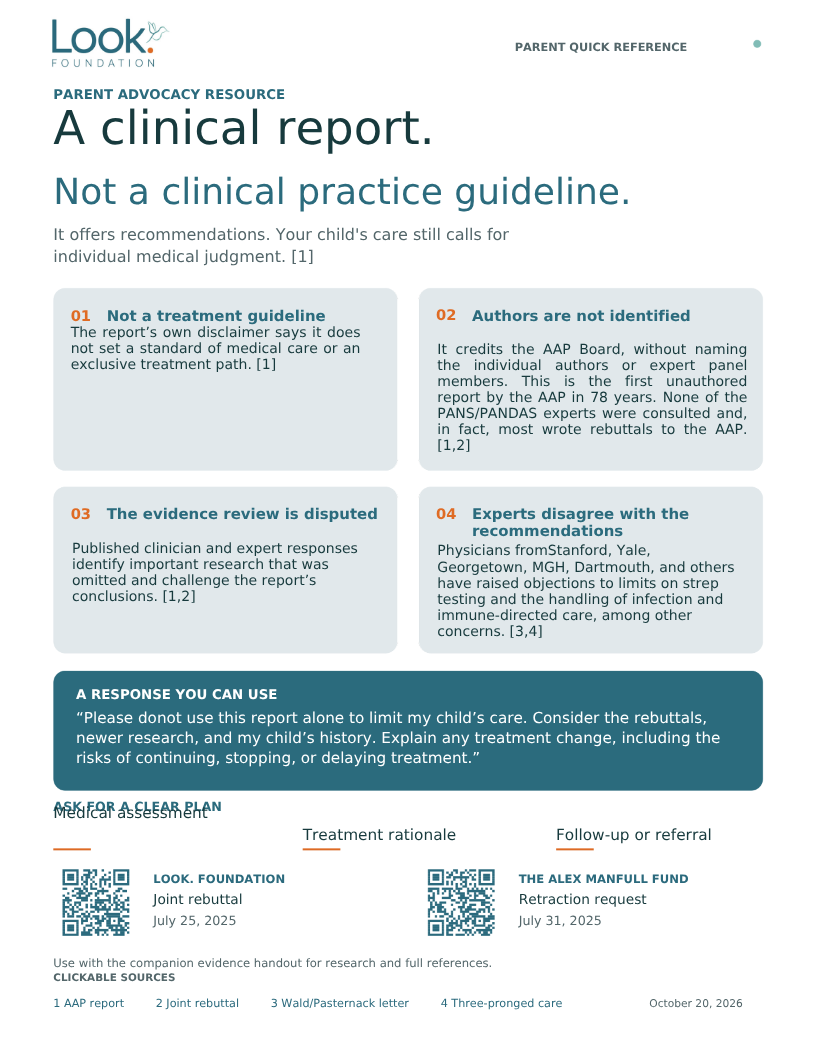
Follow the sources
References and further reading
- AAP Board. PANS Clinical Report. Pediatrics. 2025. Includes Tang’s posted response. Read source 1
- Joint rebuttal. July 25, 2025. Look. Foundation and four other signatories. Read source 2
- Wald ER, Pasternack MS. Another Perspective: Should We Swab for Group A Streptococcus? Pediatrics. 2025. Read source 3
- Bernstein GA et al. Advocating for a 3-Pronged Approach to Treating PANS. Pediatrics. 2025. Read source 4
- Melamed I et al. IVIG response, pro-inflammatory monocytes, and neuropsychiatric measures. Front Immunol. 2024. Read source 5
- Han VX et al. Epigenetic, ribosomal, and immune dysregulation in PANS. Mol Psychiatry. 2025. Read source 6
- Octapharma. Phase 3 PANZYGA results. 2025. NCT04508530. Sponsor announcement. Read source 7
- PANS Research Consortium. JCAP management series. 2017. Overview and Parts I-III. Read source 8
- Wayne CR, Akcan U et al. Th17 cytokines and microglial and endothelial responses in a mouse model of post-streptococcal encephalitis. Nat Commun. 2026. Read source 9
- The Alex Manfull Fund. AAP report retraction request. July 31, 2025. Read the request